
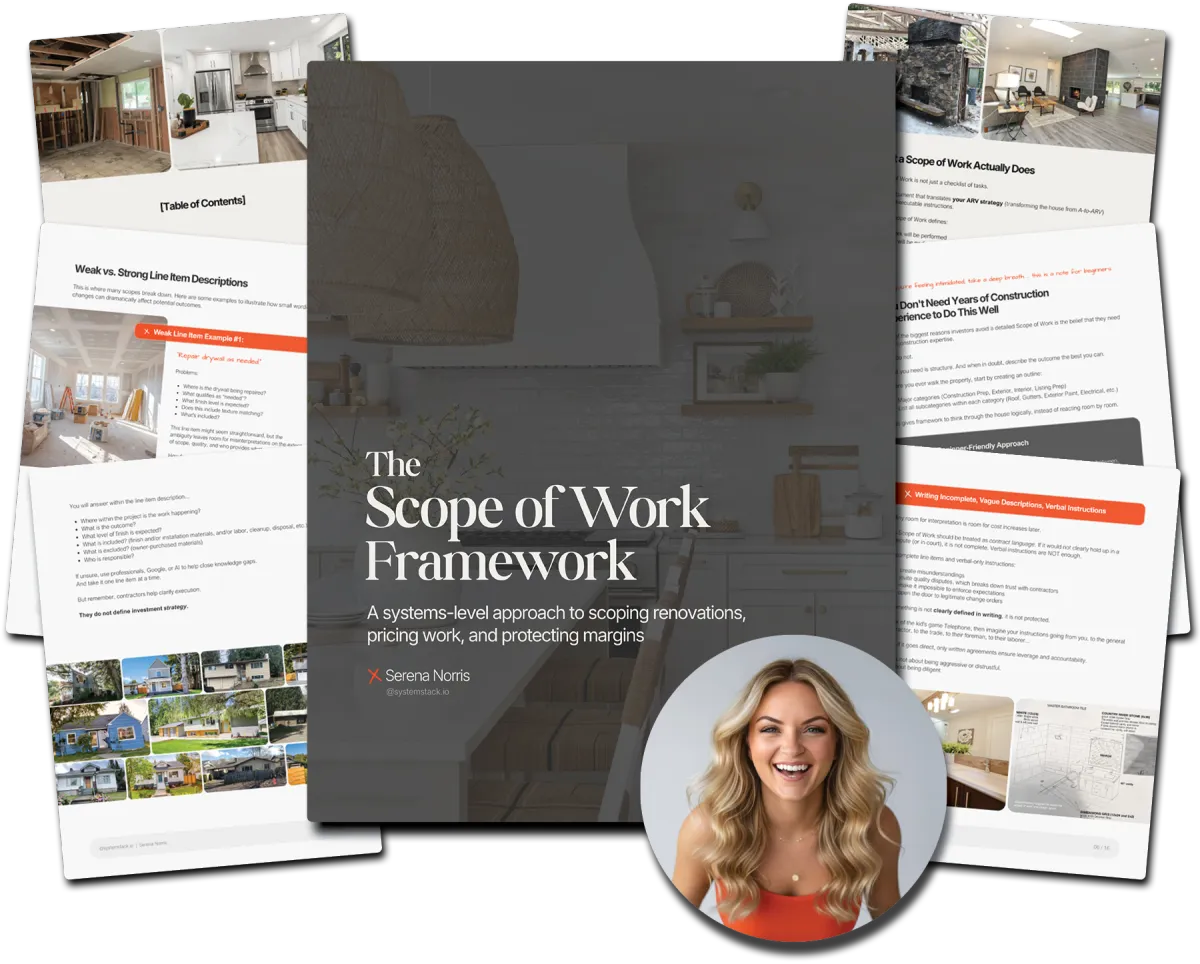
Get My Free Scope of Work Framework Guide
A systems-level approach to structuring scopes that eliminate vague bids, reduce change orders, and protect your margins.
Used across 130+ flips and $55M in executed volume
Inside the guide you'll learn:
Why most scopes fail before construction even begins
Weak vs. Strong line item examples
How to structure scopes so contractors bid apples-to-apples
Connecting scope directly to budgeting and cost tracking
How to make scope the engine within your operating system
And the biggest mistake investors make when writing scopes.
I’ve worked with dozens of value-add investors and the same challenges show up over and over again.
The root of most renovation problems?
The Scope of Work was never structured correctly from the start.
Projects start with assumptions instead of clarity, and then...
Inconsistent contractor estimates
Budgets overrun
Change orders appear
Constant reactive management
And suddenly the deal is hard to control
Because if you don’t control the scope, you don’t control the deal.
Most assume this is just part of construction.
It isn't. It starts with the scope.
This framework was developed while running high volume flipping operations across more than 130 projects and $55M in executed volume.
It reflects how professional operators structure scopes to protect profit and control projects.
I've learned the hard way how projects can get out of control quickly, and I don't want that for you.
My hope is that this guide gives you clarity and helps put you on the path to successful flipping to achieve your goals in real estate investing.

Get the Guide 👇🏼

“I met Serena at the BP Rookie Conference in 2022 and working with her completely changed how I operate. Before, I had no system and was letting contractors run the show. Her step-by-step framework gave me structure and the confidence to lead my projects instead of reacting to them.”
– Malik L., Fix & Flip Investor • Baltimore, MD

"Once I implemented Serena’s systems, everything changed. I finally had clarity on costs, structure in my process, and started operating like a real business instead of a hobby. I feel significantly more confident taking on future flips.”
– Alek S., Fix & Flip Investor • Denver, CO
I'm currently rolling out SystemStack privately with a limited group of operators to refine and pressure-test it before public release.
Join the waitlist for early access and special pre-launch offers.
After joining, you'll receive The Scope of Work Framework, a guide that shows why most scopes fail and how to structure yours correctly from day one.
x Serena
"Once I implemented Serena’s systems, everything changed. I finally had clarity on costs, structure in my process, and started operating like a real business instead of a hobby. I feel significantly more confident taking on future flips.”
– Alek S., Fix & Flip Investor • Denver, CO
“I met Serena at the BP Rookie Conference in 2022 and working with her completely changed how I operate. Before, I had no system and was letting contractors run the show. Her step-by-step framework gave me structure and the confidence to lead my projects instead of reacting to them.”
– Malik L., Fix & Flip Investor • Baltimore, MD
"Once I implemented Serena’s systems, everything changed. I finally had clarity on costs, structure in my process, and started operating like a real business instead of a hobby. I feel significantly more confident taking on future flips.”
– Alek S., Fix & Flip Investor • Denver, CO
“I met Serena at the BP Rookie Conference in 2022 and working with her completely changed how I operate. Before, I had no system and was letting contractors run the show. Her step-by-step framework gave me structure and the confidence to lead my projects instead of reacting to them.”
– Malik L., Fix & Flip Investor • Baltimore, MD
Used across 130+ flips and $55M in executed volume
Get my Free Scope of Work
Framework Guide
A systems-level approach to structuring scopes that eliminate vague bids, reduce change orders, and protect your margins.
Inside the guide you'll learn:
Why most scopes fail before construction even begins
Weak vs. Strong line item examples
How to structure scopes so contractors bid apples-to-apples
Connecting scope directly to budgeting and cost tracking
How to make the scope the engine within your system
And the biggest mistake investors make when writing scopes.
👇🏼 Get the guide
I’ve worked with dozens of value-add investors and the same challenges show up over and over again.
The root of most renovation problems?
The Scope of Work was never structured correctly from the start.
Projects start with assumptions instead of clarity, and then...
❌ Inconsistent contractor estimates
❌ Budgets overrun
❌ Change orders appear
❌ Constant reactive management
❌ And suddenly the deal is hard to control
Because if you don’t control the scope, you don’t control the deal.
Most assume this is just part of construction.
It isn't. It starts with the scope.
This framework was developed while running high volume flipping operations across more than 130 projects and $55M in executed volume.
It reflects how professional operators structure scopes to protect profit and control projects.
I've learned the hard way how projects can get out of control quickly, and I don't want that for you.
My hope is that this guide gives you clarity and helps put you on the path to successful flipping to achieve your goals in real estate investing.
"Once I implemented Serena’s systems, everything changed. I finally had clarity on costs, structure in my process, and started operating like a real business instead of a hobby. I feel significantly more confident taking on future flips.”
– Alek S., Fix & Flip Investor • Denver, CO
“I met Serena at the BP Rookie Conference in 2022 and working with her completely changed how I operate. Before, I had no system and was letting contractors run the show. Her step-by-step framework gave me structure and the confidence to lead my projects instead of reacting to them.”
– Malik L., Fix & Flip Investor • Baltimore, MD
"Once I implemented Serena’s systems, everything changed. I finally had clarity on costs, structure in my process, and started operating like a real business instead of a hobby. I feel significantly more confident taking on future flips.”
– Alek S., Fix & Flip Investor • Denver, CO
“I met Serena at the BP Rookie Conference in 2022 and working with her completely changed how I operate. Before, I had no system and was letting contractors run the show. Her step-by-step framework gave me structure and the confidence to lead my projects instead of reacting to them.”
– Malik L., Fix & Flip Investor • Baltimore, MD
Copyright © 2026. SystemStack™ by Serena Norris is a DBA of SC Home Solutions, LLC. All Rights Reserved.
Privacy • Terms • Disclaimer